Balancing services › Separators & Centrifuges
Separator & Centrifuge Balancing — In-Situ, at Operating Speed
Disc-stack separators, decanter centrifuges and basket centrifuges spin at high speed — even a few grams of unbalance generate enormous destructive forces. Product build-up, erosion and repair welds continuously throw them off. We balance the bowl or basket in place, at operating speed, with no dismounting and no process interruption — eliminating the root cause of bearing failure, seal wear and vibration trips in a single on-site session.
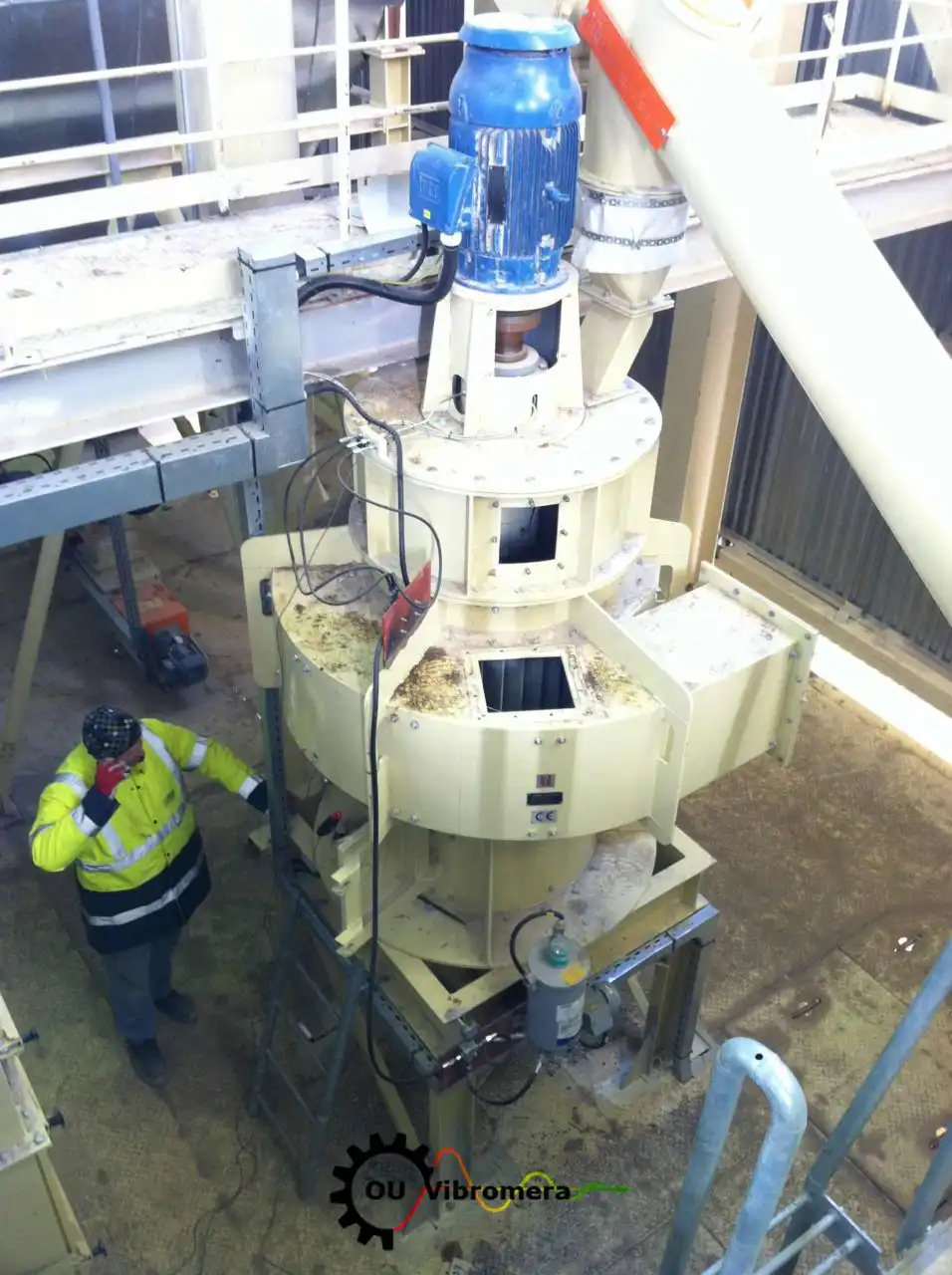
In short: Separator and centrifuge balancing is carried out in-situ, at normal operating speed, using the influence-coefficient method. A vibration accelerometer on the bearing housing and a laser tachometer on the shaft measure the unbalance state; the Balanset-1A calculates the exact correction mass and placement angle. No dismounting, no pipe work, no separate balancing machine — a typical single-plane job is complete in under one hour, reducing vibration by 70 % or more and extending bearing life by a factor of eight or more.
Signs your separator or centrifuge is out of balance
High-speed bowls and baskets are unforgiving — unbalance announces itself quickly and in ways that compound into expensive failures if left uncorrected:
Why separator bowls and centrifuge baskets lose balance — and what it costs
A new separator leaves the factory balanced to a fine grade, but service life continuously erodes that state. Uneven product and sediment build-up inside the bowl adds asymmetric mass shot by shot; abrasive feeds erode one side of the basket or disc stack faster than the other; corrosion pitting removes material unevenly; weld repairs and replacement wear rings add localised weight. Because centrifugal force scales with the square of rotational speed, a 5 g offset at 1,500 rpm becomes a 20 g-equivalent load at 3,000 rpm and a 45 g-equivalent load at 4,500 rpm.
The financial consequences accumulate fast: bearing changeouts every few months, mechanical-seal replacements, unplanned line stoppages triggered by the vibration cut-out, and — in the worst case — a bowl burst that damages the housing and injures nearby personnel. A single field-balancing session typically costs a fraction of one bearing replacement and removes the load that was causing all the damage.
Why halving vibration multiplies bearing life
How we balance a separator or centrifuge — step by step
Field balancing with the Balanset-1A follows the influence-coefficient method — a systematic four-to-five step procedure you can carry out yourself on site, with the machine running at full operating speed:
- Mount the sensors. A vibration accelerometer is fixed to the main bearing housing (or spindle frame); a laser tachometer is aimed at a reflective strip on the rotating shaft or bowl flange. No disassembly is required — the separator runs under normal operating conditions throughout.
- Measure the baseline. One full-speed run records vibration amplitude and phase angle, establishing the current unbalance vector in both magnitude and direction.
- Add a trial weight. A known test mass is clamped to a convenient point on the bowl rim, basket flange or balance ring. A second run shows the influence coefficient — how the rotor responds to a specific mass at a known angular position.
- Let the device calculate. The Balanset-1A applies the influence-coefficient algorithm to compute the exact correction mass and angular placement — one plane for compact disc-stack bowls, two planes for long decanter drums or assembled rotors with significant axial mass distribution.
- Fit the correction weight and verify. Add or remove the calculated mass at the indicated angle. A final measurement run confirms residual unbalance is within the ISO 21940-11 tolerance band for the rotor’s balance grade. The device saves a balancing report for your maintenance records.
What we balance
- Disc-stack separators (cream, milk, oil)
- Horizontal decanter centrifuges
- Solid-bowl centrifuges
- Basket (peeler) centrifuges
- Industrial washing-machine drums
- Cyclone and classifier rotors
- Cream and vegetable-oil separators
- Pharmaceutical and chemical centrifuges
- Sludge and wastewater decanters
- High-speed assembled rotor systems
Tolerances & standards
ISO 21940-11 (formerly ISO 1940-1) sets rigid-rotor balance quality grades from G0.4 to G4000. High-speed separator bowls and centrifuge baskets typically require G1.0 or G0.4 — the tightest grades — because residual unbalance is magnified by the square of rotational speed. The permissible residual unbalance Uper = G × m × 9550/n (g·mm), where m is rotor mass in kg and n is maximum speed in rpm.
For food-grade dairy and beverage separators, relevant hygienic-design standards (EHEDG, 3-A) additionally restrict the use of external balance weights that contact product zones; correction may be made by material removal (grinding) or weights secured inside dedicated balance-ring grooves. We balance to the grade your application demands and document the achieved residual-unbalance figure. Use our residual-unbalance calculator to find the permissible tolerance before you start.
The Balanset-1A — your complete field-balancing kit
Everything on this page is done with one portable instrument: the Balancet-1A. It is a two-channel dynamic balancer and vibration analyzer that balances separator bowls and centrifuge baskets in their own bearings, at operating speed, using the 3-run influence-coefficient method — the software calculates the exact correction mass and angle and saves a report.
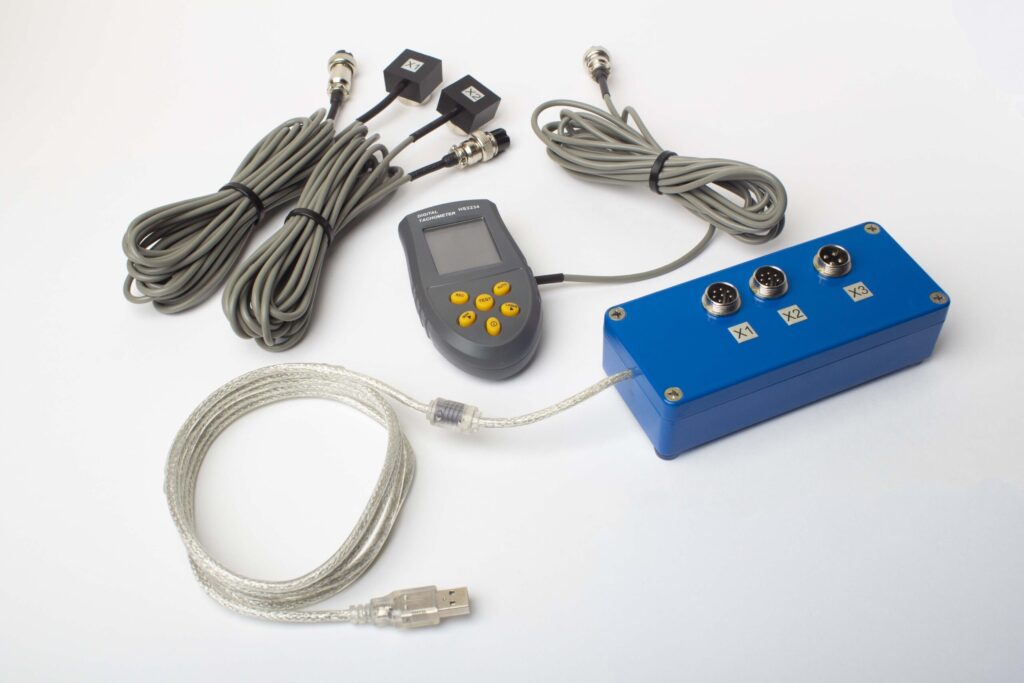
What’s in the Full Kit
€1,975 · Full Kit, in stock, VAT invoice
- Interface measurement unit (USB, 2 channels)
- Two vibration accelerometers (4 m cable, 10 m optional)
- Laser tachometer / optical phase sensor (50–500 mm)
- Magnetic stand for the sensor
- Digital scale for trial & correction weights
- Windows balancing & analysis software
- Plastic transport case
Full Kit
Unit · 2 sensors · laser tachometer · magnetic stand · digital scale · software · transport case. Everything needed to start balancing out of the box.
OEM set
Unit · 2 sensors · laser tachometer · software. For integrators who already have a stand, scale and case, or who embed the unit into a balancing machine.
| Parameter | Value |
|---|---|
| Measurement channels | 2 (single- & two-plane balancing) |
| Vibration velocity range | 0.05–100 mm/s |
| Frequency range | 5–300 Hz |
| Measurement accuracy | ±5% of full scale |
| Method | 3-run influence-coefficient (1 or 2 planes) |
| Analysis | Amplitude & phase at 1×, FFT spectrum & waveform, saved reports |
| Laptop | Not included (Windows PC, available on request) |
Field balancing vs balancing machine — which is right for your centrifuge?
| Factor | Field balancing (Balanset-1A) | Balancing machine (workshop) |
|---|---|---|
| Rotor removed from machine? | No — runs in place | Yes — full disassembly required |
| Production downtime | Sensor fitting only (<15 min) | Hours to days (disassemble, transport, balance, reassemble) |
| Balancing speed | Actual operating speed & conditions | Separate low-speed spindle |
| Accounts for assembly flex & fit | Yes — full assembly balanced as built | Bowl or basket only |
| Hygiene risk (food-grade) | Low — no dismounting of product-contact parts | Higher — reassembly may introduce contamination |
| Standards met | ISO 21940-11 (G1.0 / G0.4) | ISO 21940-11 |
| Equipment cost | €1,975 (Full Kit) | €15,000 – €80,000+ |
| Typical job time | <1 hour on site | 1–4 days total |
Field balancing is the preferred choice whenever the separator or centrifuge can be run safely and the rotor satisfies the rigid-rotor criterion. A workshop machine remains appropriate for brand-new bowls with zero run time, or for rotors that must be disassembled for other reasons (disc-stack reconditioning, basket re-weaving).
Real separator & centrifuge cases
Assembled separator balancing
Full-assembly in-situ balancing of a disc-stack separator to G1.0.
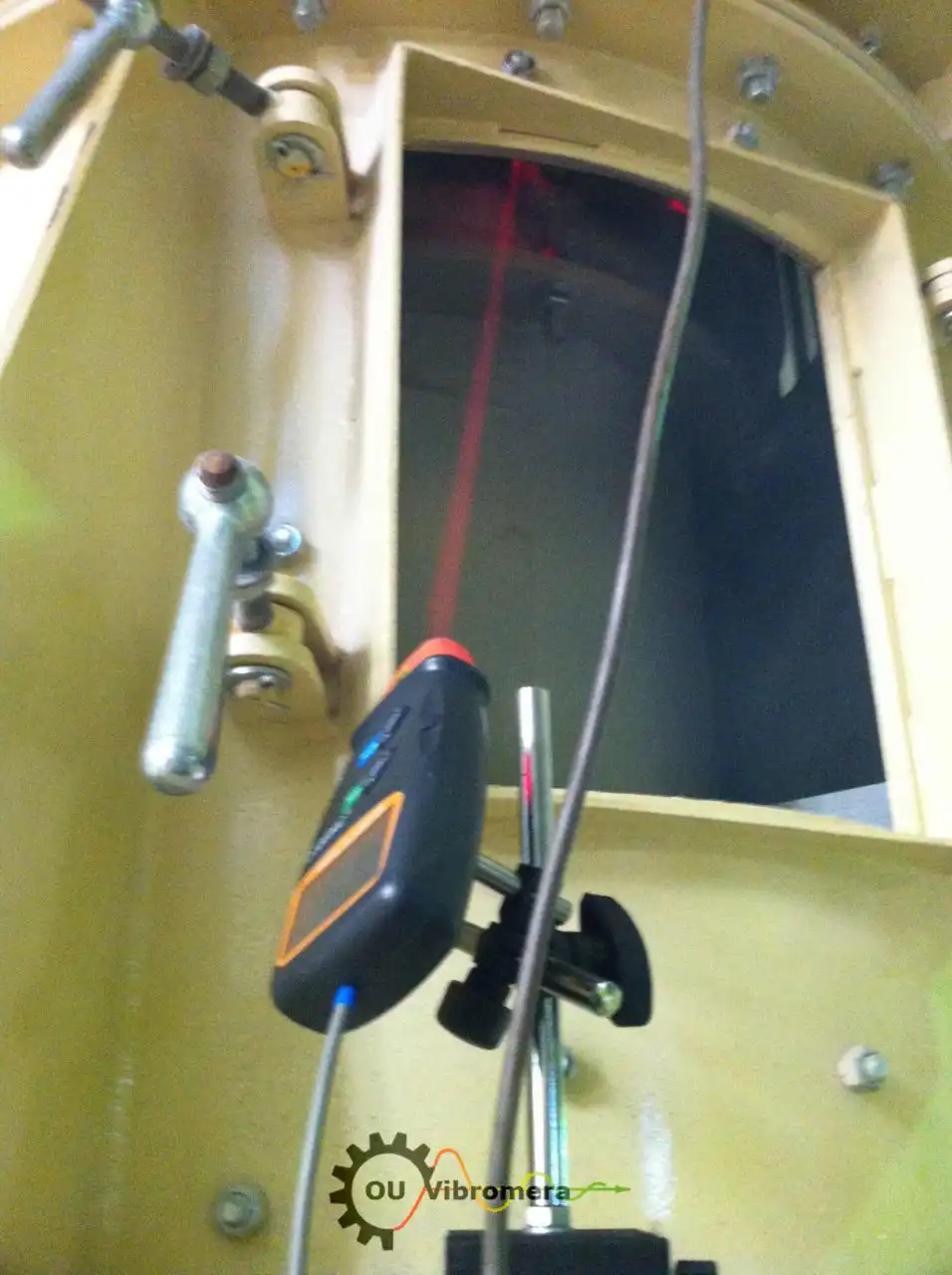
Separator rotor field balancing
Step-by-step field balancing of a separator rotor at operating speed.
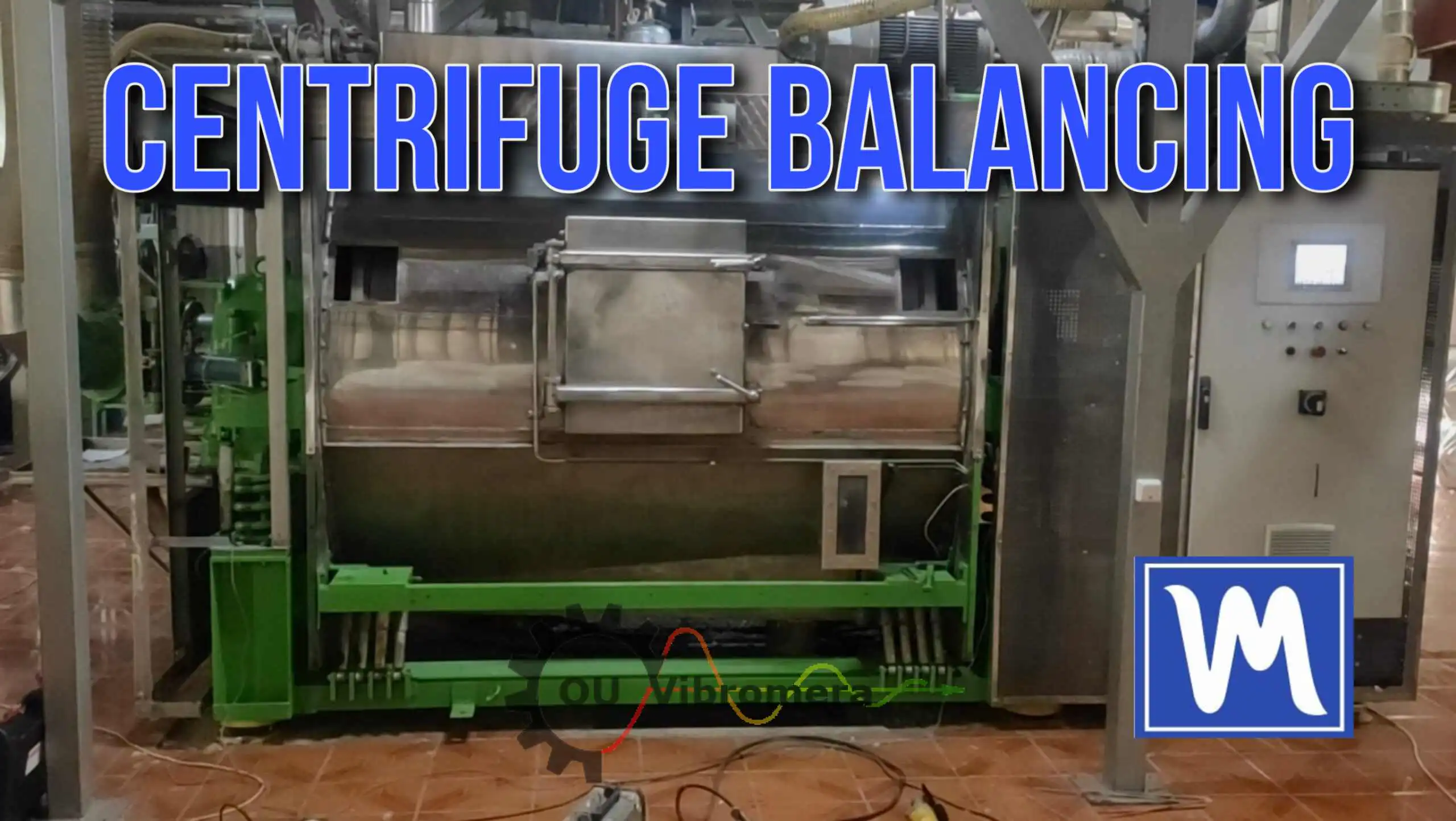
Industrial washing-machine rotor
How to balance a centrifuge drum on an industrial washing machine.
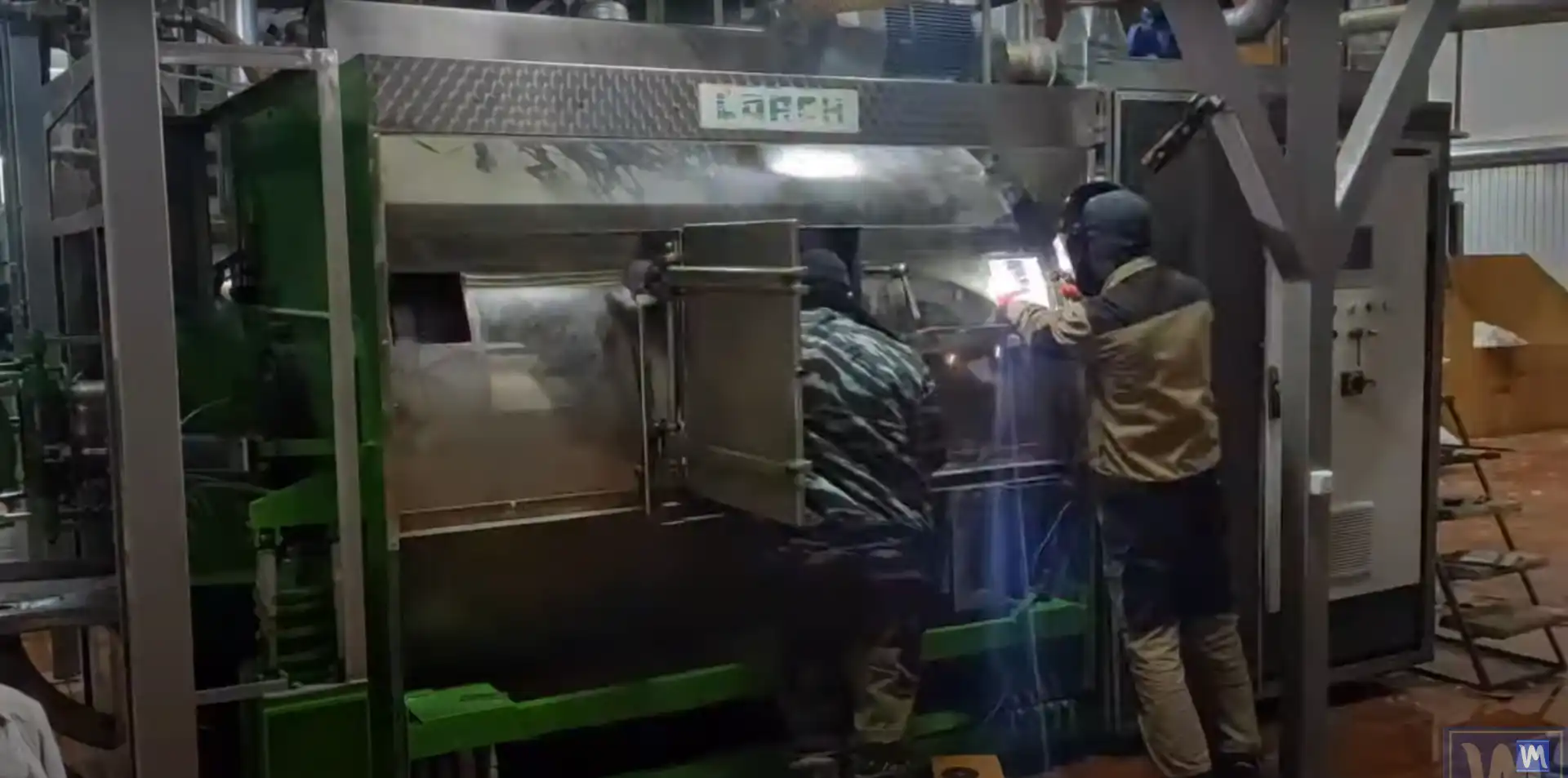
Prevention beats breakdown
Why a regular balancing schedule pays for itself many times over.
The case for centrifuge balancing
How routine balancing extends machine life in industrial operations.
Free separator & centrifuge calculators
Learn the theory
Separator & centrifuge balancing FAQ
Does the separator need to be dismantled to balance it?
Why are high-speed separators so sensitive to unbalance?
One plane or two for a separator bowl or centrifuge drum?
My centrifuge vibrates after cleaning — is it still unbalance?
Can a maintenance technician do it themselves with the Balanset-1A?
What balance grade do separators and centrifuges need to meet?
Balance your separator bowl or centrifuge basket — in place, today
The Balanset-1A guides you through single- and two-plane balancing of separator and centrifuge rotors at running speed, calculates the exact correction weight and angle, and documents the result to ISO 21940-11 grade G1.0 or G0.4. No dismounting, no lost production — just a quieter, safer, longer-lasting machine.

