割草机和林业粉碎机转子平衡: 完全野外指南
你的碎枝机轴承寿命只有两周,而不是两年。拖拉机驾驶室抖动得厉害,仪表盘都跟着嘎嘎作响。你试过更便宜的轴承、更紧的螺栓,甚至焊接加固——但都没用。 转子不平衡。 本指南将用来自现场的真实数据,向您展示如何准确解决这个问题。
转子平衡究竟做什么
Every rotating object has a mass distribution. If that mass isn't symmetrical around the axis of rotation, the rotor pulls to one side as it spins. At 2,000 RPM — a typical flail-rotor speed, reached from the 540 or 1,000 RPM PTO through the belt drive — even a 35-gram offset at 15 cm radius generates over 轴承上承受22公斤的离心力, 每转一圈,每秒 33 次。
转子平衡 这意味着要调整质量分布——增加或移除少量配重——直到离心力相互抵消。转子围绕其几何中心旋转,而不是围绕重心摆动。振动降低,轴承负载降低,机器不再试图自行解体。
For flail mowers and forestry mulchers, the rotor is a long steel drum carrying anywhere from 20 to 80 swinging flails or fixed teeth. These rotors are large, heavy, and nearly impossible to perfectly manufacture. Every weld bead, every flail bracket, every variation in wall thickness creates a small mass asymmetry. The sum of those asymmetries is the unbalance.
重要性何在:力量、失败与金钱
Unbalance isn't a nuisance — it's a destructive force. The centrifugal force from an unbalanced rotor grows with the 正方形 of the RPM. Double the speed, quadruple the force. At operating speed, a moderate unbalance subjects every component in the machine to a hammering cyclic load.
什么部件最先损坏(以及维修费用是多少)
- 轴承 take the direct hit. Bearing life falls with the 立方体 of the load (ISO 281): a 30% higher dynamic load roughly halves it, and a doubled load cuts it by about 8×. In practice, operators who balance report 3–5× longer bearing life. Quality bearing sets cost €50–€100 each, but the real damage is the 2–4 hours of downtime per replacement. Some operators replace bearings every few days.
- 轴承座 轴承座因过度松动而变形。一旦轴承座呈椭圆形,即使更换新轴承也无法正常运转。轴承座维修或更换费用:200-500欧元。
- 螺栓和紧固件 螺栓松动会持续发生。振动机器上的每一个螺栓都试图自行松脱。螺栓松动意味着刀片脱落、防护罩脱落、生产损失——以及安全隐患。
- 车架焊缝开裂。 长时间的振动会导致割草机机身出现疲劳裂纹。你会发现加固板被焊接在之前的加固板上——这台机器就像一个拼凑起来的弗兰肯斯坦,每次维修都会进一步降低其结构完整性。
- 液压接头泄漏。 振动会导致连接松动和密封表面加工硬化。流体泄漏会导致过热和泵损坏。
- 拖拉机也受到了影响。 振动会通过动力输出轴和三点式悬挂装置传递到拖拉机上。驾驶室支架、传动轴万向节,甚至拖拉机上的液压阀体都可能出现损坏。
- 操作员以现金方式支付。 长时间全身振动暴露与肌肉骨骼损伤有关。一些操作人员反映,下班后数小时内仍能感觉到手部振动。
农业转子振动的ISO标准
这里有两个标准至关重要。 ISO 21940-11 (formerly ISO 1940-1) defines balance quality grades — how much residual unbalance is acceptable for a given rotor type. ISO 10816-3 (现为 ISO 20816-3)定义了振动严重程度区域——轴承座可接受的振动量。
| ISO 21940-11 等级 | 应用 | 示例设备 |
|---|---|---|
| G40 | 粗农机械 | 曲轴驱动机械,刚性转子,低转速 |
| G16 | 农业机械,通用 | 旋耕式割草机、林业碎枝机、锤式粉碎机 |
| G6.3 | Agricultural machinery, smooth-running; general machinery | High-RPM shredders, process fans, pump impellers |
| G2.5 | Turbomachinery, precision drives | Gas and steam turbines, turbo-generators, machine-tool drives |
| 公差带 | 振动(毫米/秒 RMS) | 意义 | 需要采取的行动 |
|---|---|---|---|
| A | < 1.4 | 全新机器状态 | 无 — 优秀 |
| B | 1.4 - 2.8 | 适合长期运行 | 定期监测 |
| C | 2.8 - 4.5 | 仅适用于短期 | 尽快计划维护 |
| D | > 4.5 | 危险——存在损坏风险 | 停止机器运转。立即修复。 |
A note on those zone values: ISO 10816-3 was written for industrial machine sets, not for mounted implements — we use it as the closest available reference, and the rigid-support column above is the conservative choice. If the mower is carried on a three-point hitch or a boom (a flexible support whose first natural frequency is below running speed), the corresponding Group 2 flexible-support boundaries are 2.3 / 4.5 / 7.1 mm/s.
A single bearing replacement on a flail mower takes 2–4 hours and costs 50-100欧元 就零件而言。如果振动导致你每两周而不是每 12 个月更换一次零件,那大约会造成…… 24 extra replacements per year — €1,200–€2,400 in parts plus 48–96 hours of lost work time.
合同季期间一天的停工都可能造成损失。 500欧元至1000欧元 收入损失。灾难性故障(轴裂、转子损坏)是指 1500欧元至3000欧元以上 更换零件需要数周时间。
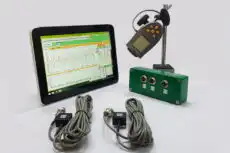
Balanset-1A 的成本 €1,975 只需一次。避免一两次轴承故障就能收回成本。之后每次维修都是纯粹的节省。
装备类型及其平衡特性
Not every mower or mulcher behaves the same way. The rotor geometry, flail type, and operating RPM all affect how unbalance develops and how you correct it.
旋耕式割草机(动力输出轴驱动)
The most common type. Horizontal drum with Y-blades or hammer flails on pivoting brackets. Unbalance usually comes from uneven flail wear, lost flails, or mud buildup. These elongated drums have a length-to-diameter ratio far above 0.5, so two-plane balancing is needed. Replace worn flails in opposite pairs before balancing.
林业碎枝机(挖掘机式)
Heavier rotors with fixed carbide teeth. Unbalance develops as teeth wear unevenly or break off during impact with stones and buried metal. These rotors run on hydraulic drives — the RPM can vary, so hold speed steady during measurement. Heavier rotors need heavier trial weights — size them with the same force rule (centrifugal force about 5–10% of rotor weight).
路边/路侧割草机
Higher RPM for fine cutting, making them more sensitive to unbalance. Often has a lighter rotor with many small flails. Even slight unbalance produces noticeable vibration. Target G6.3 grade for smooth operation. Hollow drums can accumulate debris inside — clean before balancing.
树桩粉碎机/土地清理滚筒
The heaviest rotors in this category. Low RPM but massive centrifugal forces due to weight. Unbalance from broken teeth and weld repairs. Often requires two operators — one to run the machine, one to monitor the Balanset. Corrective weights can be 200–500 g per plane.
Static vs Dynamic Unbalance: Why the "Knife-Edge" Method Falls Short
传统方法很简单:将转子放在两个刀口支架(或一对圆杆)上,让它自由滚动,并在较重的一侧加配重。当转子不再自行转动时,就达到了"平衡"。这种方法适用于…… 静态不平衡 — 质心偏离旋转轴。
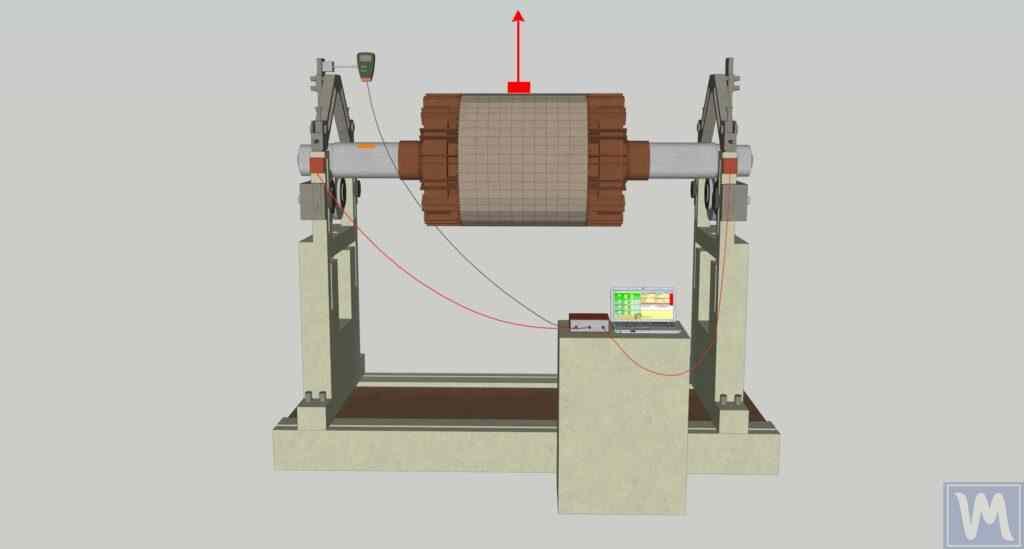
对于较窄、类似圆盘的转子(长径比低于约 0.5),静平衡可能已经足够 —— 前提是工作转速和测得的轴承响应支持这一点。可以把它想象成单皮带轮或砂轮 —— 重量分布误差本质上只存在于一个平面内。
割草机滚筒很长。一台典型的动力输出轴式割草机上,1.5米长的滚筒的长径比为3:1或更高。想象一下,滚筒一端在12点钟位置有一个重点,另一端在6点钟位置有一个重点。在刀刃状的支撑结构上,这两个重点相互平衡——转子保持水平,看起来"平衡"。"
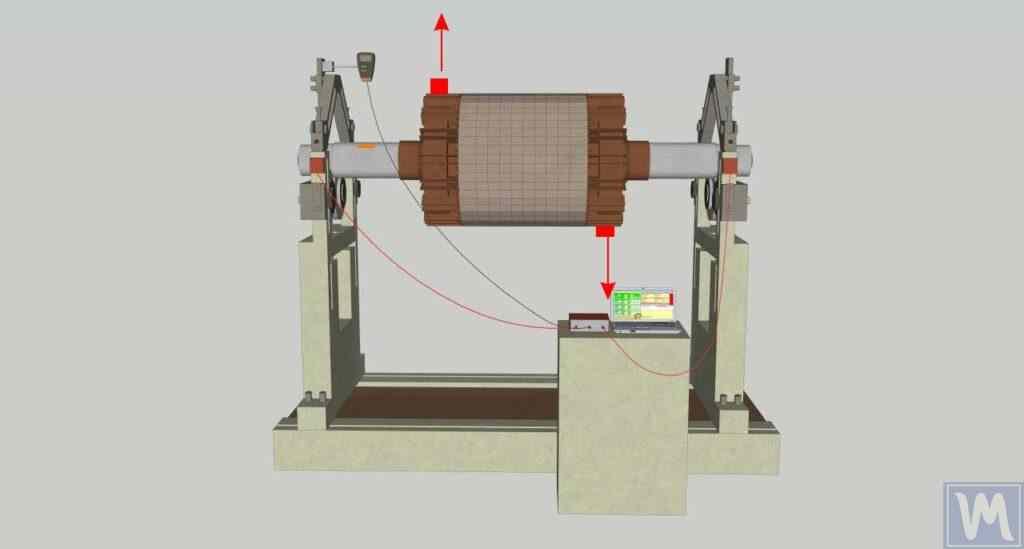
让同一个转子以每分钟 2000 转的速度旋转,每个重点都会产生向外拉的离心力。结果是…… 力偶 ——一种使转子前后摇摆的扭转力。这是 偶不平衡 — the pure-couple case of dynamic unbalance, which in general combines static and couple components — and it's invisible when the rotor is stationary.
经验法则: 只有对于长径比低于约 0.5 的较窄、类似圆盘的转子,并且仅在工作转速和测得响应支持的情况下,才值得考虑单平面(静)平衡。细长转子以及具有显著偶响应的转子需要双平面平衡。对于几乎所有甩刀式割草机滚筒、林业碎枝机滚筒和粉碎机转子,这意味着动平衡是唯一有效的方法。
为什么店铺平衡还不够
Some operators send their rotors to a machine shop for bench balancing. The shop mounts the rotor in a balancing machine with its own precision bearings and measures the unbalance. They add weights, verify, and send it back. The rotor returns "perfectly balanced."
你重新安装了软件,但它仍然会震动。为什么?
- 不同的轴承。 这家店的平衡机配备的是精密轴承,间隙几乎为零。而你割草机的轴承则存在工作间隙,有些磨损,而且轴承座可能已经磨损严重。你机器上的转子中心位置与他们机器上的略有不同。
- 配合公差。 When you bolt the rotor back in, the shaft-to-bearing fit, keyway alignment, and pulley or coupling position may not be identical to the shop setup. Even 0.01 mm of eccentricity at the coupling introduces unbalance.
- 运行条件。 在负载作用下,链锤向外摆动,其质量分布发生变化。转子管在工作温度下的热膨胀会使平衡点发生偏移。动力输出轴的对准和传动带的张力会影响轴承的负载。
原位平衡 (在转子安装于机器上时进行动平衡)考虑到了所有这些实际运行因素。传感器测量轴承在实际运行条件下所承受的压力。这就是为什么现场测试结果通常优于车间测试结果的原因——而且转子无需离开机器。
准备工作:预平衡检查清单
动平衡可以校正质量分布,但无法修复损坏的部件。准备工作花的每一分钟,都能节省之后十分钟的故障排除时间。
- 清洁转子。 清除所有结块的泥土、缠绕的铁丝、植被和杂物——包括桶内外(空心桶)。即使是50克干泥也会起到意想不到的配重作用。
- 检查轴承。 抓住转子轴靠近每个轴承的位置,检查是否存在间隙——任何径向或轴向的松动都意味着需要先更换轴承。低速旋转时,注意是否有摩擦声或咔嗒声。
- 检查每一把连枷和锤子。 All must be present, swing freely, and be roughly the same weight. If one is broken or heavily worn, replace it and its diametrically opposite partner. Missing flails are the #1 cause of unbalance in flail mowers.
- 检查是否有裂缝。 检查转子管、端板、链锤支架和机架焊缝。转子裂纹会产生无法平衡的不规则振动——裂纹在离心力作用下会改变形状。
- 检查皮带张力/动力输出轴对准情况。 A loose belt slips and gives inconsistent RPM. A misaligned PTO shaft introduces vibration that isn't from unbalance. Fix these first.
- 检查是否有软足。 所有安装螺栓都拧紧了吗?割草机是否水平放置?安装不平整会产生共振,从而放大振动。
- 接触转子前,请先锁定/挂牌发动机。拔出钥匙。如有配备,请接合动力输出轴制动器。
- 焊接、打磨或进行任何试运行时,请佩戴护目镜。
- 在测试运行(转子旋转)期间,所有人员必须远离旋转平面。转速为 2000 转/分钟的松散试验砝码会像抛射体一样飞出。
- 使用听力保护装置——裸露的割草机滚筒在运转转速下很容易超过 95 分贝。
- 切勿在动力输出轴 (PTO) 运转时将手伸入转子区域。如有需要,请在转子静止时使用绳索或棍棒粘贴反光胶带。
使用 Balanset-1A 的 7 步现场平衡程序
这是影响系数法,即 Balanset-1A 整个过程自动化。您只需进行三次测量,然后安装永久性矫正配重。软件会自动处理所有三角函数计算。
预检和准备
完成以上清单。标记平面 1(靠近轴承 1,通常是驱动端)和平面 2(靠近轴承 2,自由端)。您将在这些位置安装试配重和永久性修正件。
Weigh your trial weight on a precision scale. Size it by centrifugal force, not by a percentage of rotor mass: pick a mass whose centrifugal force is about 5–10% of the rotor's weight, m = (0.05–0.10) · M · g / (R · ω²), where M is the rotor mass, R is the mounting radius, and ω = 2π·n/60 is the angular speed. A good trial weight changes the vibration reading by at least 20–30% in amplitude or 20–30° in phase.
安装传感器和转速表
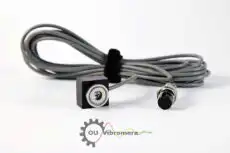
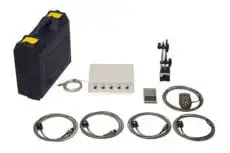
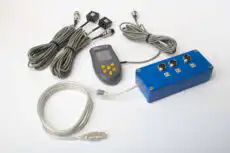
将振动传感器 1 安装在轴承座的平面 1 上,将传感器 2 安装在平面 2 上。使用磁性底座并调整传感器方向。 垂直于转子轴线 (水平方向通常信号最强)。清洁安装表面——油污和油漆会降低磁吸力。
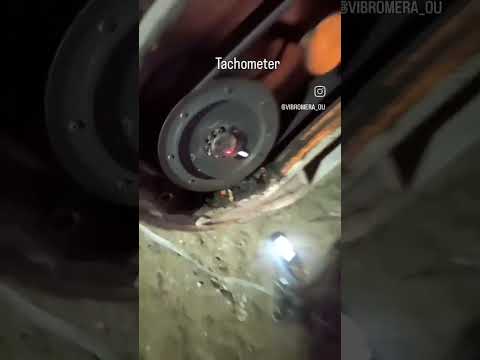
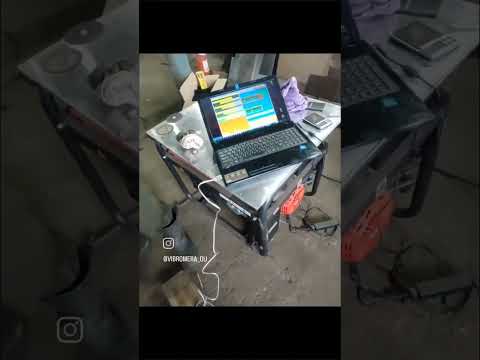
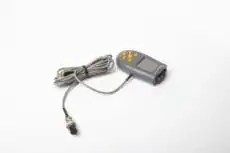
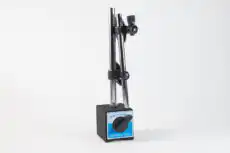
Stick reflective tape on the rotor or pulley. Mount the laser tachometer on its magnetic stand, aimed so the laser hits the tape throughout rotation. Connect sensors to Balanset-1A inputs (X1, X2, X3 for the tachometer; newer revisions are labeled Ch-1, Ch-2, Tacho). Connect to laptop via USB.
运行 0 — 记录初始振动
启动 Balanset 软件。选择 F3 - Two-plane, 然后 F7 - Balancing. Create a new record. Start the rotor at operating RPM (typically around 2,000 RPM at the rotor, driven from the 540 or 1,000 RPM PTO). Wait 5–10 seconds for speed to stabilize. Record baseline vibration amplitude (mm/s) and phase angle at both sensors.
Always measure at the real working speed. Pivoting flails only straighten out fully under centrifugal load, so their mass distribution — and therefore the unbalance you measure — is speed-dependent. A correction computed at reduced speed will not hold at working speed. For the same reason, check between runs that no flail has re-seated on its pin: if the flails sit differently in Run 0 and Run 1, the influence coefficients are worthless and you must start over.
Note these values — they're your "before" numbers. Anything above 2.8 mm/s indicates serious unbalance. Above 4.5 mm/s is in the danger zone (Zone D) per ISO 10816-3.
How big should a trial weight be?
A safe starting point is a weight whose centrifugal force stays within 5–10% of the rotor weight. As a formula:
m试重 = k · M · g / (R · ω²), k = 0.05–0.10
其中 M is the rotor mass (kg), g = 9.81 m/s², R is the mounting radius of the weight (m), and ω = 2π·RPM/60 (rad/s). Example: a 50 kg rotor at 3,000 rpm with the weight at R = 0.2 m gives m ≈ 0.07·50·9.81/(0.2·314²) ≈ 1.7 g — grams, not hundreds of grams. That looks surprisingly small for a 50 kg rotor, but check the force: at 3,000 rpm those 1.7 g already pull F = m·R·ω² ≈ 34 N — about 7% of the rotor's weight. Starting small is the point: stepping up is cheap, while an oversized weight is a real load on bearings and welds. The same force check works in reverse for any weight you are about to bolt on.
You don't have to compute this by hand: the Balanset software includes a First Trial Weight Estimator that recommends both the mass and the starting angle from your rotor data, and a 碰撞测试 to check that you are not working near a natural frequency.
A good trial weight changes the reading by at least 20–30% in amplitude or 20–30° in phase. If the response is smaller, increase the weight stepwise — never jump straight to a heavy weight "to see something happen."
运行 1 — 试验重量 1
停止转子运转。在软件中输入试验砝码的质量(克)和半径(毫米)。将试验砝码牢固地用螺栓固定在链轮支架上,或将其临时焊接在滚筒上。 平面 1. 标记角度位置(从反光胶带标记处沿旋转方向测量)。
启动转子。安装试验砝码后记录振动情况。停止转子。 移除试验重量。
Check: did the vibration amplitude change by at least 20–30%, or the phase shift by at least 20–30°? If not, use a heavier trial weight and repeat this run.
运行 2 — 试验机 2 的重量
安装 相同试验重量 在 平面 2 (靠近另一个轴承)。标记角度位置。运转转子,记录读数。停止。 移除试验重量。
本次运行结束后,软件已获得所需的所有数据——三次振动测量(运行 0、运行 1、运行 2),且试验配重位置已知。软件由此计算影响系数,并确定精确的校正配重。
安装永久性矫正配重
软件会显示两个结果:平面 1 的修正重量、质量和角度,以及平面 2 的修正重量、质量和角度。根据计算出的质量切割钢材(使用天平——精度至关重要)。从参考标记沿旋转方向测量角度。
将修正配重焊接在计算好的位置。务必使用熔透良好的焊缝——这些配重必须能够承受多年的动力输出轴振动和冲击。
核实并记录
最后一次运行转子。软件会将新的振动与原始振动进行比较。目标: 低于 1.4 mm/s 为优秀(A 区), under 2.8 mm/s for good (Zone B). If residual vibration is too high, the software offers a trim run — Run T - Trim — one additional run with the corrections installed to verify and fine-tune the result.
将报告保存到 Balanset 软件中。在贴在机器上的标签上写明平衡日期和残余振动值。这将成为您的维护基准线。
完毕。 整个过程通常在操作几次后需要 45 到 90 分钟。机器现在应该运行得明显更顺畅——操作人员经常说感觉就像换了一台机器一样。
实地考察报告:葡萄牙中部林业粉碎机
机器: 液压林业粉碎机,安装在20吨挖掘机上。转子直径500毫米,长度1200毫米,重量约380公斤。48个固定硬质合金齿。由液压马达驱动,转速为1800转/分。
问题: 三个月来,操作员每隔10-14天就要更换一次主轴承。粉碎机框架的安装点处有明显的裂纹——这些安装点之前已经焊接过两次。挖掘机操作员反映驾驶室内振动过大。承包商平均每周因轴承更换和停机损失400欧元。
我们的发现: 滚筒一端缺失两颗齿(撞击埋在地下的混凝土所致)。其中一颗齿开裂并部分脱落。更换全部三颗齿并清理空心滚筒内部的干泥后,测量了初始振动。 12.8 毫米/秒 在驱动端轴承处 9.4 毫米/秒 在自由端——深入 ISO D 区(危险)。
平衡程序: 使用 Balanset-1A 进行双平面动态平衡。试砝码:120 克螺栓。校正砝码:平面 1 上 142° 处 85 克,平面 2 上 267° 处 110 克。焊接在滚筒端板上。
结果: 残余振动降至 1.2 毫米/秒 at the drive end (Zone A) and 1.6 毫米/秒 at the free end (Zone B, close to the 1.4 mm/s A/B boundary). Total job time including tooth replacement: 2.5 hours. Balancing procedure alone: 55 minutes.
How to check the result against ISO 21940-11: for a 380 kg rotor at 1,800 RPM, grade G16 allows Uper = 9,549 · 16 · 380 / 1,800 ≈ 32,254 g·mm in total, i.e. about 16,127 g·mm per plane — roughly 65 g at the 250 mm weld radius. The corrections we installed (85 g and 110 g) were of that same order, and the post-balance residual was well inside the limit.






故障排除:平衡后仍然振动?
您已按照步骤操作,安装了矫正配重,但振动几乎没有变化。在质疑设备之前,请先系统地检查以下三个方面。
1. 机械故障(最常见)
- 磨损或损坏的轴承 即使是全新的廉价轴承也可能存在内部间隙过大的问题。安装后请检查间隙。
- 弯曲的轴 — a bent shaft creates 1× RPM vibration that looks like unbalance but can't be corrected by adding weights. Check shaft runout with a dial indicator: more than 0.05 mm TIR (total indicated runout) is a problem.
- 缺失或不均匀的连枷 — a single missing 500 g hammer at 200 mm radius creates 500 g × 200 mm = 100,000 g·mm (100 g·m) of unbalance — potentially more than the entire rotor had before balancing.
- 桶内有碎屑 — 空心转子内部夹杂的泥土、砾石或植被会随着旋转而移动,导致振动读数不稳定且无法重复。
- 框架或安装件破裂 裂纹会改变机器的刚度,并可能产生共振。按压机架的不同位置,并注意振动音调的变化。
- 任何地方的螺栓松动 — 检查割草机上的每一个紧固件、三点式挂钩和动力输出轴连接。
2. 平衡期间的条件
- 谐振 — if the operating RPM coincides with a natural frequency of the machine (structural resonance), even a perfectly balanced rotor produces high vibration. Try balancing at a slightly different RPM (±10%) if possible; on a pivoting-flail rotor, re-verify at the true working speed afterwards.
- 转速不稳定 —拖拉机发动机转速在所有三次运行中必须保持稳定。如果动力输出轴(PTO)转速变化超过 5%,则相位数据不可靠。
- 两次跑步之间发生了一些变化 — 传感器发生位移、拖拉机移动、链锤脱落、传送带打滑。如果任何测量条件发生变化,则从运行 0 重新开始。
3. 平衡程序错误
- 试用重量太轻 — 如果第 0 次试验和第 1 次试验之间的振动变化小于 20%,则软件的计算精度会下降。请使用更重的试验砝码。
- 忘记取出试验砝码了。 — 在安装永久性矫正器之前,请务必确认已移除试用配重。这是最常见的错误。
- 角度测量错误 —角度必须从反光胶带标记沿旋转方向测量。反向旋转测量会导致重量偏差180°。
- 转速表未对准 — 如果激光器在运行过程中发生偏移,相位读数就会出现偏差。务必将其牢固固定。
- 阳光干扰 — 光学转速表在阳光直射下可能会漏检。请遮蔽传感器。
- 矫正配重放置在错误的半径处 该软件针对特定半径进行计算。如果您在不同的半径处焊接配重,则有效修正值会成比例变化。

常见问题
我可以在不将转子从割草机上拆下来的情况下进行平衡吗?
是的——而且这是首选方法。现场动平衡是指转子留在机器上。您只需将传感器连接到轴承座,通过动力输出轴 (PTO) 驱动转子运转,Balanset-1A 就会计算出修正值。由于它考虑了实际的轴承间隙、轴承座对准情况以及运行载荷,因此结果通常优于车间动平衡。大多数现场作业需要 45 到 90 分钟。
我的割草机需要哪种 ISO 21940-11(原 ISO 1940)平衡等级?
大多数旋耕式割草机和林业碎枝机都属于以下范畴 G16级 (通用农业机械)。高转速路边割草机和精密碎枝机可能会受益于 G6.3. The Balanset-1A software includes an ISO 1940 tolerance calculator: you select the balance grade and enter the rotor mass and RPM, and it outputs the permissible residual unbalance in g·mm — total and per plane. To get the correction weight in grams, divide the g·mm value by your correction radius in mm.
转子应该多久重新平衡一次?
这取决于你的工作环境。在林业和土地清理(清理石块、掩埋的碎石、高强度作业)中,要定期检查平衡情况。 100-200 工作小时 或者当你更换齿的时候。在轻型牧场割草作业中,, 每季一次 通常情况下就足够了。更换链锤、轴承或对转子进行任何机械改动后,务必重新进行动平衡。
为什么我的割草机在维修店做了转子平衡后仍然会震动?
The shop balanced the rotor in their machine with their precision bearings — not yours. When you reinstall the rotor, differences in bearing fit, housing wear, keyway alignment, and PTO runout re-introduce unbalance that didn't exist on the bench. In-situ balancing after reinstallation typically reduces vibration further because it corrects for everything in the actual operating environment.
在正常转速下使用试验砝码是否安全?
是的,只要正确固定即可。试验砝码必须是 螺栓连接或焊接 — never taped or wire-tied. Size it so its centrifugal force stays within 5–10% of the rotor's weight: m = (0.05–0.10) · M · g / (R · ω²). The Balanset-1A shows live vibration during each run, so you can monitor whether the trial weight is making things better or worse and stop immediately if needed. All personnel must stand clear of the plane of rotation during runs.
使用 Balanset-1A 需要接受特殊培训吗?
无需正式认证。软件会引导您完成每个步骤——安装传感器、运行转子、连接测试配重、再次运行、安装校正数据。大多数操作员在 2-3 次练习后就能熟练掌握。Vibromera 提供 视频教程, 它还提供详细的使用手册和WhatsApp直接技术支持。设备会自动处理所有计算——您只需按照提示操作,并在指定位置进行焊接即可。
你的割草机不必抖动
不平衡的转子会不断造成损害——轴承、焊缝、螺栓、拖拉机以及操作人员都会受到影响。但这并非无法解决。只要做好充分的准备,并使用像……这样的便携式平衡机,就能轻松解决这个问题。 Balanset-1A, 你可以从……拿走一台机器 振动速度从 12.8 毫米/秒降至 1.2 毫米/秒 不到一个小时,就在现场,无需拆卸转子。
这项投资只需避免一两次轴承故障即可收回成本。真正的回报在于随后数月的无故障运行——无需再每日更换轴承,车架不再开裂,驾驶室面板也不再嘎嘎作响。
平衡转子。从源头上解决问题。其他问题都会迎刃而解。


0 Comments