Understanding Laser Shaft Alignment



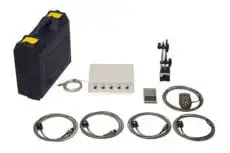



Laser shaft alignment is a high-precision measurement technique used to bring the rotational centrelines of two or more coupled machines — such as a motor and a pump — into a true straight line. The goal is for the shafts to be collinear when the machines are running at their normal operating temperature and load, not merely when they are cold and stationary. Together with precision balancing, alignment is one of the two foundations of low vibration in rotating machinery.
1. Definition: What is Laser Shaft Alignment?
Proper alignment is one of the single most important factors in the reliability and longevity of rotating machinery. Laser systems have largely replaced older, less accurate methods such as straightedges and dial indicators as the industry standard for this critical task, because they remove the reading errors, bracket sag and arithmetic mistakes that dogged the manual methods. Precision alignment is a cornerstone of any proactive, condition-based maintenance program.
2. Why is Alignment So Critical?
When two shafts are misaligned, the flexible coupling between them is forced to bend and flex continuously through every revolution. This cyclic stress generates large dynamic forces that are fed straight into the machine’s bearings, seals and shafts.
Misalignment is a root cause of a large share of machinery failures, leading to:
- Premature bearing and seal failure.
- Coupling damage and failure.
- High vibration — classically at 1× and especially 2× the running speed, often accompanied by elevated axial vibration.
- Increased energy consumption from frictional losses.
- Shaft fatigue and potential breakage.
By performing a precision laser alignment these destructive forces are minimised, dramatically improving reliability. It is worth distinguishing the two basic forms of misalignment the process must remove: parallel (offset) misalignment, where the centrelines are parallel but displaced, and angular misalignment, where they meet at an angle. Most real machines suffer a combination of both in the vertical and horizontal planes simultaneously.
3. How Laser Alignment Systems Work
A typical laser shaft alignment system has two main components:
- A laser emitter/detector unit, mounted on one machine shaft.
- A reflector or second detector unit, mounted on the other machine shaft.
The procedure runs as follows:
- The units are clamped to the shafts, usually with chain brackets.
- The laser beam from the emitter is aimed at the detector on the opposite unit.
- The shafts are rotated together while the detectors track the precise relative movement of the beam through the rotation. Readings are typically taken at three positions — for example the 9, 12 and 3 o’clock points.
- A handheld computer receives the detector data and uses trigonometry to compute the exact alignment condition in both the vertical and horizontal planes.
- The results are displayed graphically as offset (the distance between the shaft centrelines) and angularity (the angle between them).
- Crucially, the computer then calculates the precise shim changes needed under the machine feet to correct the vertical misalignment, and the horizontal moves needed to correct the horizontal misalignment. A “live move” feature lets the technician watch the alignment come into tolerance in real time as adjustments are made.
The required shim stacks can be planned in advance with a Shim Thickness Calculator, and the final result checked against speed-based limits using a Shaft Alignment Tolerance Calculator.
4. Key Considerations for Precision Alignment
Achieving a genuine precision alignment takes more than the laser system alone. A trained technician must also address several other factors:
- Soft foot: a condition in which a machine foot does not sit flat on the baseplate, distorting the frame when it is bolted down. Soft foot must be found and corrected before alignment begins, and can be quantified with a Soft Foot Calculator.
- Thermal growth: machines change their alignment state as they heat from cold (stopped) to hot (running). The system can be loaded with thermal offset values so the machines are deliberately misaligned cold and grow into perfect alignment at operating temperature; a Thermal Growth Compensation Calculator helps predict those offsets.
- Pipe strain: force from poorly supported connected piping can pull a machine out of alignment and must be relieved.
- Tolerances: alignment is performed to specific, industry-standard tolerances set by the machine’s running speed — the higher the speed, the tighter the tolerance required.
5. Alignment, Balancing and the Vibration Spectrum
Alignment and balancing are complementary but distinct. A 2× running-speed peak in the vibration spectrum usually points to misalignment, whereas a dominant 1× peak more often indicates residual unbalance — though the two can coexist and be confused. Because they overlap, good practice is to verify alignment first and then balance. A portable two-channel analyser such as the Balanset-1A lets the same engineer confirm the alignment by reading the 1× and 2× amplitude and phase in the machine’s own bearings, and then, if a 1× component remains, balance the rotor in place — closing out both root causes during a single visit without a trip to a balancing machine.

