Balancing services › Rolls & Drums
Roll & Drum Balancing — In-Situ, at Production Speed
Paper-machine rolls, printing cylinders, calender drums, dryer rolls and conveyor drums share one characteristic: even a small mass eccentricity generates enormous centrifugal force at production speed. We balance them in place, at operating speed — no teardown, no shipping to a workshop — eliminating the root cause of product defects, bearing failures and web breaks in a single on-site session.
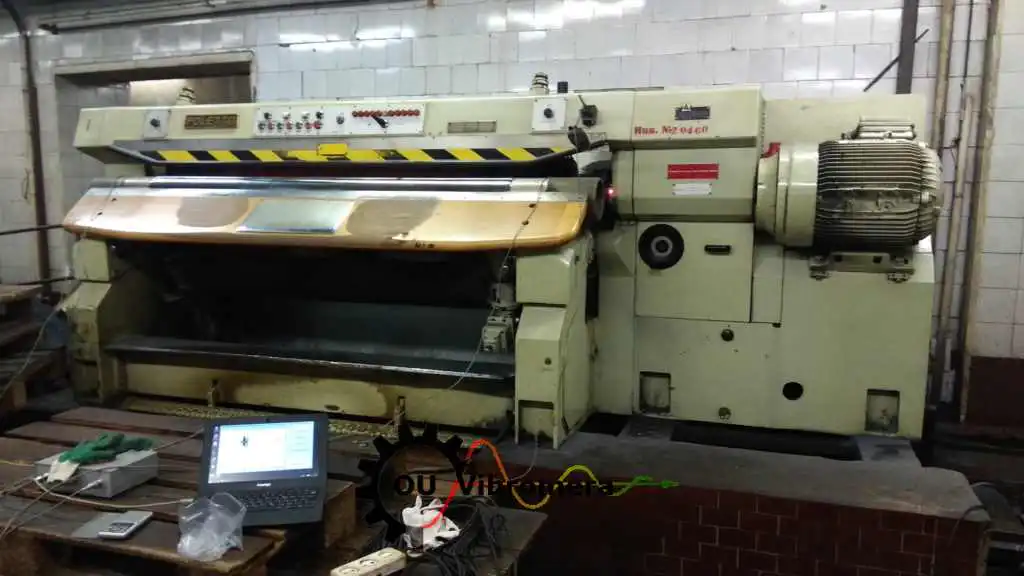
In short: Roll and drum balancing is performed in-situ at normal production speed using the two-plane influence-coefficient method. Vibration sensors on both bearing housings and a laser tachometer on the shaft capture the unbalance state; the Balanset-1A calculates the exact correction mass and angle for each end of the roll. No dismounting, no line shutdown beyond sensor fitting — most jobs are complete within one hour and reduce vibration by 70 % or more, eliminating product-quality defects and multiplying bearing life by a factor of eight or more.
Signs your roll or drum is out of balance
Rolls and drums often run for hours before an operator notices something is wrong. These are the signals that unbalance is at work:
Why rolls and drums lose balance — and what it costs
A freshly ground roll leaves the workshop within tight balance tolerances, but service conditions continuously attack that state. Uneven coating or rubber wear on the roll surface redistributes mass gradually; product build-up and dried residue accumulate asymmetrically inside hollow dryer drums; re-covering or re-grinding operations remove material non-uniformly; and thermal distortion during hot calendering can shift the effective centre of mass between production shifts. Because centrifugal force scales with the square of angular velocity, a sub-millimetre eccentricity that seems harmless at slow speed becomes a destructive dynamic load at full production RPM.
The downstream cost of ignoring roll unbalance compounds quickly: wasted rolls of off-spec product, unplanned stoppages for bearing changes, re-grind cycles that shorten roll service life, and structural fatigue in the machine frame. Field balancing addresses all of these at source and typically pays for itself the first time it prevents an unplanned stoppage.
Why halving vibration multiplies bearing life
How we balance a roll or drum — step by step
The Balanset-1A applies the influence-coefficient method adapted to the geometry and access constraints of roll-and-drum installations. The same systematic procedure can be carried out by your own maintenance team on site:
- Mount the sensors. Vibration accelerometers are fixed to both end-bearing housings and a laser tachometer is aimed at a reflective strip on the shaft or end-plate. The machine runs at normal production speed throughout — no disassembly, no pipe or frame removal.
- Measure the baseline. A run at full production speed records vibration amplitude and phase angle at both bearing planes, establishing the current unbalance state in magnitude and direction at each end of the roll.
- Add a trial weight. A known test mass is clamped or bolted at a specified angular position on one roll end-plate, collar or journal. A second run shows how each plane responds to that known perturbation — the influence coefficient for that roll and speed.
- Let the device calculate. The Balanset-1A solves the two-plane influence-coefficient equations and outputs the correction mass and clock angle for each end of the roll or drum body.
- Fit the correction weights. Correction masses are bolted, welded or clamped at the calculated positions on both ends of the drum body or roll journals. Trial weight is removed unless it forms part of the solution.
- Verify and document. A final run at production speed confirms residual unbalance is within the ISO 21940-11 grade required for the roll class and operating speed. The Balanset-1A generates a report documenting before-and-after unbalance values for your maintenance records.
What we balance
- Paper-machine press, dryer and calender rolls
- Printing and flexographic impression cylinders
- Coating and laminating rolls
- Conveyor head and tail drums
- Rubber-covered and polyurethane-clad rolls
- Leather-processing and embossing cylinders
- Steel and cast-iron industrial process drums
- Textile calendar and finishing rolls
- Rotary drying drums and kilns
- Custom hollow cylinders and mandrels
Tolerances & standards
ISO 21940-11 (formerly ISO 1940-1) defines residual specific unbalance limits for rigid rotors as a function of service speed and balance quality grade G. Paper-machine press and dryer rolls are commonly balanced to G 1.0 or G 2.5 because even small vibration at production speed causes measurable product defects; heavy conveyor and process drums may be accepted at G 6.3.
For paper-machine rolls specifically, ISO 5343 / TAPPI TIP series provides additional guidance on roll vibration acceptance limits at running speed, including critical-speed margins and nip-pressure uniformity requirements. We confirm the grade achieved in a documented residual-unbalance report delivered at the end of every job. Use our paper-machine roll balance calculator to pre-calculate the permissible residual unbalance for your roll dimensions and speed before starting the job.
The Balanset-1A — your complete field-balancing kit
Everything on this page is done with one portable instrument: the Balanset-1A. It is a two-channel dynamic balancer and vibration analyzer that balances rolls and drums in their own bearings, at production speed, using the 3-run influence-coefficient method — the software calculates the exact correction mass and angle for each end of the roll and saves a documented report.
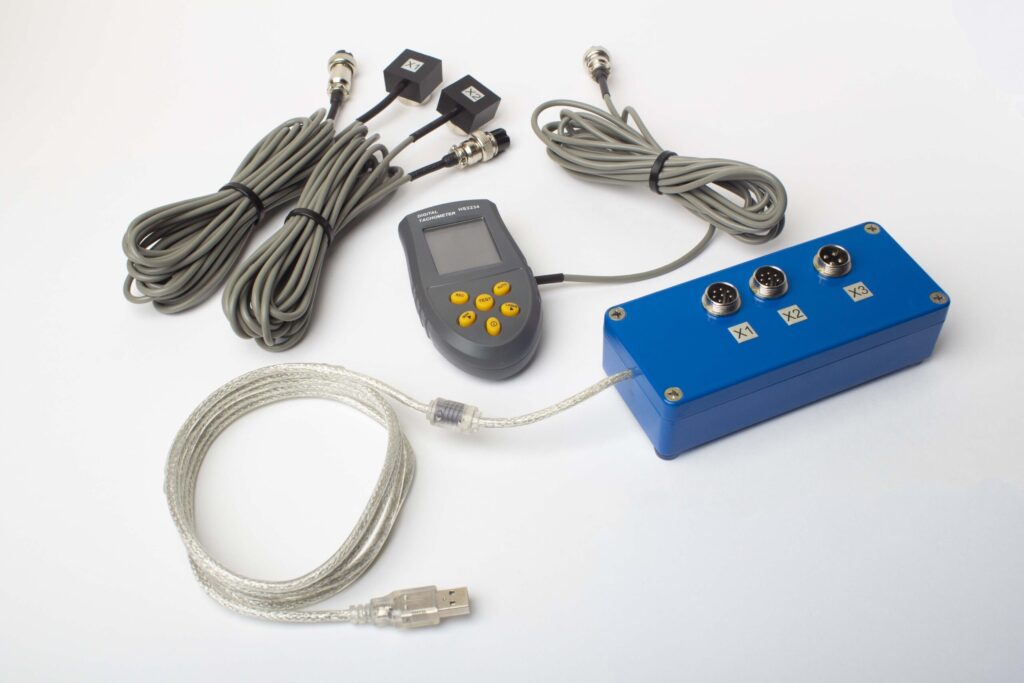
What’s in the Full Kit
€1,975 · Full Kit, in stock, VAT invoice
- Interface measurement unit (USB, 2 channels)
- Two vibration accelerometers (4 m cable, 10 m optional)
- Laser tachometer / optical phase sensor (50–500 mm)
- Magnetic stand for the sensor
- Digital scale for trial & correction weights
- Windows balancing & analysis software
- Plastic transport case
Full Kit
Unit · 2 sensors · laser tachometer · magnetic stand · digital scale · software · transport case. Everything needed to start balancing rolls and drums out of the box.
OEM set
Unit · 2 sensors · laser tachometer · software. For integrators who already have a stand, scale and case, or who embed the unit into a dedicated roll-balancing machine.
| Parameter | Value |
|---|---|
| Measurement channels | 2 (single- & two-plane balancing) |
| Vibration velocity range | 0.05–100 mm/s |
| Frequency range | 5–300 Hz |
| Measurement accuracy | ±5% of full scale |
| Method | 3-run influence-coefficient (1 or 2 planes) |
| Analysis | Amplitude & phase at 1×, FFT spectrum & waveform, saved reports |
| Laptop | Not included (Windows PC, available on request) |
Field balancing vs balancing machine — which is right for your roll?
| Factor | Field balancing (Balanset-1A) | Balancing machine (workshop) |
|---|---|---|
| Roll removed from the line? | No — runs in place | Yes — full dismounting required |
| Production line shutdown? | Sensor fitting only (<15 min) | Hours to days (remove, transport, balance, reinstall) |
| Balancing speed | Actual production speed & temperature | Separate low-speed spindle, room temperature |
| Accounts for thermal distortion | Yes — roll balanced at operating temperature | No — cold-state only |
| Accounts for shaft/coupling flex | Yes — full assembly balanced in own bearings | Roll body only |
| Standards met | ISO 21940-11, ISO 5343 / TAPPI TIP | ISO 21940-11 |
| Equipment cost | €1,975 (Full Kit) | €15,000 – €80,000+ |
| Typical job time | <1 hour on site | 1–3 days total |
Field balancing is the preferred choice whenever the roll can run and the rotor rigidity criterion is satisfied. A workshop machine remains appropriate for new-build rolls where zero run time is available, or for rolls with thermal instability so severe that they cannot reach a stable balance state at operating temperature without structural repair first.
Real roll-balancing cases
Free roll & drum calculators
Learn the theory
Roll & drum balancing FAQ
Can a roll be balanced without removing it from the machine?
Why does a freshly re-covered roll vibrate more than the old one?
What balance grade is required for a printing cylinder?
Our conveyor drum vibrates but the belt looks fine — is it the drum?
How long does a typical roll-balancing job take?
Can we do it ourselves with the Balanset-1A?
Balance your rolls and drums — in place, at production speed
The Balanset-1A performs two-plane field balancing on any roll or drum at production speed, calculates the exact correction mass and angle for each end, and delivers a documented residual-unbalance result to ISO 21940-11. No dismounting, no shipping to a workshop, no lost production — just consistent product quality, quieter machinery and bearings that last.

 English
  العربية
  Azərbaycan dili
  বাংলা
বাংলা  Български
  简体中文
简体中文  Hrvatski
  Čeština
  Dansk
Dansk  Nederlands
  Eesti
Eesti  Suomi
Suomi  Français
  ქართული
  Deutsch
  Ελληνικά
  עִבְרִית
  हिन्दी
  Magyar
  Bahasa Indonesia
  Italiano
  日本語
日本語  한국어
한국어  Latviešu valoda
  Lietuvių kalba
  Bahasa Melayu
  Norsk bokmål
  فارسی
فارسی  Polski
  Português do Brasil
  Português
  Română
  Русский
  Српски језик
  Slovenčina
  Slovenščina
  Español
  Svenska
  ไทย
ไทย  Türkçe
  Українська
  اردو
اردو  Tiếng Việt