کمپن تجزیہ میں شافٹ مدار پلاٹ کو سمجھنا






اے شافٹ مدار is a plot that shows the path traced by a rotating shaft’s geometric centre during one or more revolutions. It is a two-dimensional view of the shaft’s motion within its بیئرنگ کلیئرنس, as if you were looking straight down the end of the shaft. This powerful diagnostic is created by mounting a pair of non-contact قربت کی تحقیقات 90 degrees apart — typically in an X-Y configuration — and plotting their simultaneous displacement signals against each other rather than against time.
1. Why the Orbit Plot Is So Useful
A standard وقت کی لہر یا ایف ایف ٹی سپیکٹرم shows کمپن in a single direction. The orbit plot combines two perpendicular directions to give a complete picture of the shaft’s dynamic motion, letting analysts visualise the actual shape and direction of the movement rather than inferring it. That extra dimension provides invaluable clues for diagnosing a wide range of faults, which is why the orbit is a cornerstone of rotor-dynamic analysis — especially for high-speed, critical machinery fitted with fluid-film جرنل بیرنگ, such as turbines, compressors, and large generators.
Because the probes measure displacement directly against the bearing, the orbit also reveals where the shaft sits within its clearance, not just how far it moves — information a casing-mounted ایکسلرومیٹر simply cannot provide. Adding a ٹیکو میٹر یا کیفاسور mark stamps each revolution onto the orbit, fixing its مرحلہ and making precession direction unambiguous.
2. How to Interpret Orbit Shapes
مدار کی شکل، سائز اور واقفیت روٹر پر کام کرنے والی قوتوں کے براہ راست اشارے ہیں۔ ایک ماہر تجزیہ کار صرف مدار کی شکل دیکھ کر مشین کی حالت کی تشخیص کر سکتا ہے۔
سرکلر یا بیضوی مدار
A simple circular or elliptical orbit, centred in the bearing, typically indicates a well-behaved rotor dominated by a single frequency — most often عدم توازن. The orbit will be circular if the bearing support stiffness is the same in both directions (isotropic) and elliptical if the stiffness differs horizontally and vertically (anisotropic), which is very common in practice because most machines are stiffer vertically than horizontally.
مسخ شدہ، شکل-8، یا کیلے کی شکل کا مدار
When the orbit is distorted from a simple ellipse, multiple frequencies are influencing the shaft’s motion:
- اے "کیلا" یا ہلال کی شکل کا مدار اکثر کے ساتھ منسلک کیا جاتا ہے غلط ترتیب, where both 1× and 2× frequencies are present.
- اے شکل-8 شکل is a classic sign of a strong 2× component, a textbook indicator of shaft misalignment. A figure-8 with an internal loop often suggests a more severe condition or the presence of a rub.
کنکس یا تیز کونوں کے ساتھ مدار
سمت میں تیز تبدیلیاں، فلیٹ دھبے، یا مدار میں "کنکس" a کا مضبوط ثبوت ہیں۔ روٹر سے اسٹیٹر رگڑنا. They show that the shaft’s motion is being momentarily constrained as it makes contact with a stationary component such as a bearing, a مہر, or the machine casing.
انتہائی بے قاعدہ مدار
An orbit that is erratic, unstable, or appears filled with “noise” can signal severe mechanical ڈھیل, fluid-induced instability such as تیل کا چکر یا کوڑا, or turbulent flow conditions in a pump or compressor.
3. Direction of Precession: Forward vs Reverse
The direction in which the orbit is traced, relative to the direction of shaft rotation, is itself a key diagnostic factor:
- فارورڈ پریسیشن: the orbit traces in the same direction as shaft rotation. This is the normal behaviour for forces such as unbalance.
- Reverse precession: the orbit traces opposite to shaft rotation. This is an abnormal condition and can indicate a شافٹ کریک, a severe rub, or certain types of fluid-induced instability.
Distinguishing the two requires the once-per-revolution phase mark; without it the orbit shows shape but not the sense in which it is travelled, and the diagnostic distinction is lost.
4. The Orbit in Field Diagnostics
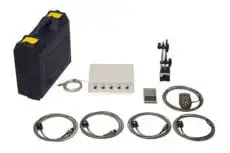
Permanently installed proximity probes feeding a monitoring system are the textbook way to capture an orbit on large critical machines, but the underlying principle — two perpendicular displacement signals plotted against each other with a phase reference — is equally available to the field engineer. A portable two-channel instrument such as the بیلنسیٹ -1 اے measures synchronous amplitude and phase on two planes at once, so once an orbit or spectrum has confirmed that عدم توازن is the dominant force, the same setup carries straight through to فیلڈ توازن and verification of the corrected state. When the orbit instead reveals misalignment, a rub, or instability, that finding redirects the work toward alignment or a mechanical fix rather than balancing.
5. What an Orbit Plot Shows
In summary, a single orbit plot delivers a wealth of information at a glance:
- شافٹ کمپن کا مجموعی طول و عرض۔
- - شافٹ کی حرکت کی شکل، جو غلطی کی قسم کی شناخت میں مدد کرتی ہے۔
- The direction of precession, forward or reverse.
- The average position of the shaft within the bearing clearance — its شافٹ کا مرکز.
Analysed in conjunction with the FFT spectrum and the time waveform, the orbit lets an analyst reach a highly confident and detailed تشخیص of a machine’s dynamic behaviour — combining the “how much,” the “what shape,” and the “which way” into one decisive picture.

